Headwinds
Manuel Camia
Official selection


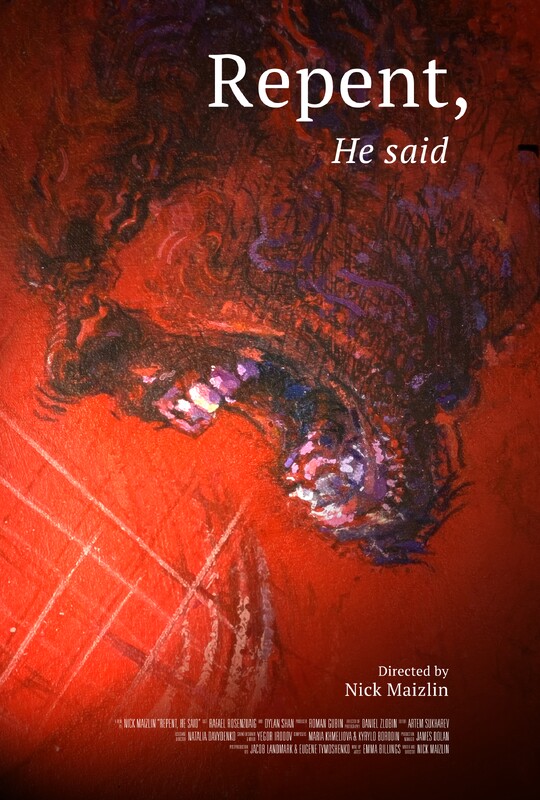
A tennis court shrouded in mist and two opponents dressed in black and white: in Nick Maizlin’s experimental short, the match becomes an encounter with guilt and isolation.
Repent, He Said is a Canadian experimental short written and directed by Nick Maizlin. Completed in 2026, it runs for seven minutes and forty-six seconds and places a tennis match in a suspended, mist-covered space. Its premise is one final encounter, in which sporting competition intertwines with the weight of past victories and what the player has sacrificed to achieve them. The court becomes the setting for a confrontation that also concerns his conscience.
Two figures, one dressed in black and the other in white, occupy opposite sides of the net. Rackets, balls, lines and the score belong to the vocabulary of tennis; alongside them, intertitles speak of hollow victories, anger, a hardening heart and loneliness. The film brings the gestures of competition together with a reflection on guilt and the possibility of repentance, without building its narrative around a biographical explanation of the protagonist.
Black-and-white photography, raking light and fog define the visual setting. Views of the court alternate with faces, hands and details of the net, while written words introduce another layer of the narrative. This combination of action and text places the short within the form of sporting allegory: the distance between the players, the boundary of the net and the presence of the scoreboard belong both to the match and to its moral meaning.
Produced by Roman Gubin and filmed in Canada, the short features Rafael Rosenzuaig and Dylan Shan in its principal cast. Daniel Zlobin’s cinematography is accompanied by editing by Artem Sukharev, music by Kyrylo Borodin and Maria Khmeliova, and sound design by Yegor Irodov. In the film’s approach to cinema and sport, tennis provides a bounded space and an encounter between two bodies through which to address the relationship between the desire to win, personal responsibility and isolation.